KNEE ALIGNMENT SPECIALIST

Knee & Leg Alignment Treatment in Nottingham & Derby

Specialist assessment of knee and leg alignment to understand its contribution to pain, joint loading and osteoarthritis.

What is correct knee and leg alignment?

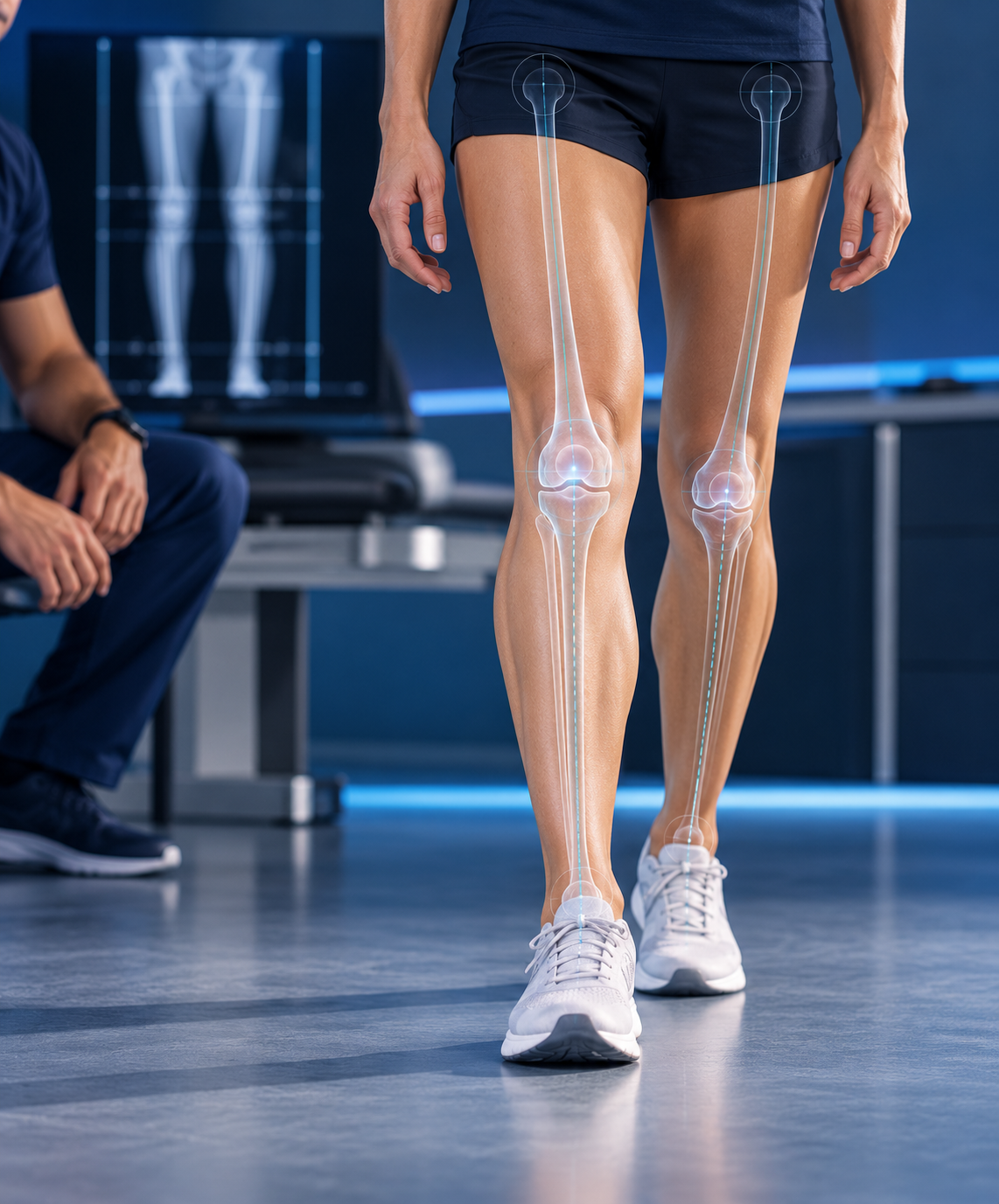
Leg alignment describes the relationship between the hip, knee and ankle and the way weight is transmitted through the leg when standing and walking.

There is natural variation in alignment between individuals, and a small degree of bow-legged or knock-kneed alignment does not necessarily cause symptoms or require treatment.

However, more significant changes in alignment can alter how load is distributed across the knee. This may place greater stress on one side of the joint and, in some patients, contribute to pain or the progression of osteoarthritis.

Varus and valgus knee alignment

Illustration showing normal, varus and valgus knee alignment

Varus alignment

In varus alignment, the knees sit further apart when the ankles are closer together. This is commonly described as bow-legged alignment and can increase loading through the inner, or medial, side of the knee.

Valgus alignment

In valgus alignment, the knees sit closer together while the ankles remain further apart. This is commonly described as knock-kneed alignment and can increase loading through the outer, or lateral, side of the knee.

Why does knee alignment matter?

The knee is designed to distribute forces across the joint as we stand, walk and exercise.

When the leg is significantly malaligned, a greater proportion of that load may pass through one part of the knee. Over time, this can be associated with increased stress on the cartilage and may contribute to osteoarthritis in the affected compartment.

Alignment is therefore one of several factors considered when assessing knee pain. Symptoms, activity level, ligament stability, cartilage damage and X-ray findings are also important.

Not everyone with varus or valgus alignment develops knee problems, and treatment decisions should be based on symptoms and the individual knee rather than appearance alone.

Symptoms associated with knee alignment problems

Changes in knee and leg alignment do not always cause symptoms. When alignment is contributing to a knee problem, symptoms may include:

  • Pain predominantly on one side of the knee
  • Pain during walking, running or other weight-bearing activity
  • Progressive bow-legged or knock-kneed appearance
  • Reduced ability to participate in sport or exercise
  • Stiffness or reduced movement
  • Symptoms associated with osteoarthritis

These symptoms can have many causes, so assessment is important before attributing knee pain to alignment alone.

How is knee and leg alignment assessed?

Assessment begins with a clinical examination of the knee and the alignment of the whole leg.

Where appropriate, standing weight-bearing X-rays can show how arthritis affects the knee while it is under load.

A long-leg alignment X-ray may also be used. This images the leg from the hip to the ankle and allows the mechanical alignment of the limb to be measured and assessed.

These findings can then be considered alongside symptoms, activity level, examination findings and the condition of the knee joint.

Can knee alignment be corrected without surgery?

Treatment depends on the cause and degree of the alignment change, the condition of the knee and how much it is affecting the patient’s symptoms and activities.

For some patients, non-operative treatment may help manage symptoms. This can include physiotherapy, strengthening, activity modification, weight management where appropriate and pain-relieving treatment.

These approaches can improve symptoms and function but do not usually change established bony alignment in an adult.

Where significant malalignment is contributing to symptoms or uneven loading of the knee, surgical realignment may sometimes be considered.

Knee alignment correction surgery

An osteotomy is an operation used to change the alignment of the leg by carefully repositioning the bone.

In appropriately selected patients, the aim is to redistribute load away from an overloaded or arthritic part of the knee and towards a healthier part of the joint.

Osteotomy is a joint-preserving procedure and may be considered for some active patients where arthritis or overload predominantly affects one part of the knee.

Suitability depends on several factors and requires individual assessment.

Illustration showing how high tibial osteotomy can change leg alignment and redistribute load through the knee

High tibial osteotomy (HTO)

A high tibial osteotomy changes alignment through the upper part of the shin bone (tibia). It is commonly considered when correction is required for certain patterns of varus, or bow-legged, alignment.

Learn more about high tibial osteotomy →

Distal femoral osteotomy (DFO)

A distal femoral osteotomy changes alignment through the lower part of the thigh bone (femur). It may be considered for certain patterns of valgus, or knock-kneed, alignment.

Learn more about distal femoral osteotomy →

The site and nature of the deformity must be assessed individually.

Find out more about patient-specific osteotomy guides →

Specialist expertise in knee alignment and joint preservation

Mr Navjot Bhangoo explaining knee treatment options to a patient using an anatomical knee model

Mr Navjot Bhangoo is a Consultant Orthopaedic Knee Surgeon specialising exclusively in knee conditions and surgery.

His practice includes joint-preserving procedures as well as partial and total knee replacement, allowing treatment decisions to be based on the individual patient’s symptoms, alignment, activity level and pattern of joint damage.

Assessment of knee alignment forms part of determining whether symptoms may be managed without surgery, whether a joint-preserving procedure such as osteotomy may be appropriate, or whether another treatment would better suit the individual knee.

Find out more about Mr Bhangoo →

Woman undergoing knee and leg alignment assessment in a specialist clinic
EXPERT CARE. A MORE ACTIVE YOU.

Concerned about your knee or leg alignment?

Arrange a consultation with Mr Bhangoo to discuss your symptoms, knee alignment and the treatment options that may be appropriate for you.

Book Appointment

Frequently Asked Questions

  • What is correct leg alignment?

    There is natural variation in leg alignment. Alignment is assessed by looking at the relationship between the hip, knee and ankle and how load passes through the leg. A small degree of varus or valgus alignment does not necessarily cause symptoms or require treatment.

  • How do I know if my knees are properly aligned?

    Visual appearance alone cannot determine whether alignment is contributing to knee symptoms. Clinical examination and, where appropriate, standing X-rays can provide a more accurate assessment.

  • What is the difference between varus and valgus knee alignment?

    Varus alignment is commonly described as bow-legged alignment, with greater loading often occurring through the inner side of the knee. Valgus alignment is commonly described as knock-kneed alignment, with greater loading often occurring through the outer side of the knee.

  • Can knee alignment cause arthritis?

    Significant malalignment can alter the distribution of load through the knee and may contribute to osteoarthritis in some patients. However, arthritis is influenced by multiple factors and not everyone with varus or valgus alignment develops arthritis.

  • Can knee alignment be corrected without surgery?

    Physiotherapy, strengthening and other non-operative treatments may improve symptoms and function, but they do not usually change established bony alignment in an adult. Whether structural correction is necessary depends on the individual patient.

  • What is knee alignment correction surgery?

    Alignment correction surgery usually involves an osteotomy, in which the bone is carefully repositioned to alter how load passes through the knee. It is a joint-preserving option for selected patients rather than a treatment required for everyone with malalignment.

  • What is an osteotomy?

    An osteotomy is an operation in which a bone is carefully cut and repositioned to change alignment. Around the knee, high tibial or distal femoral osteotomy may be used in selected patients to redistribute load across the joint.