Partial Knee Replacement: Who Is Suitable and What Are the Benefits?
A knee replacement does not always mean replacing the whole knee.
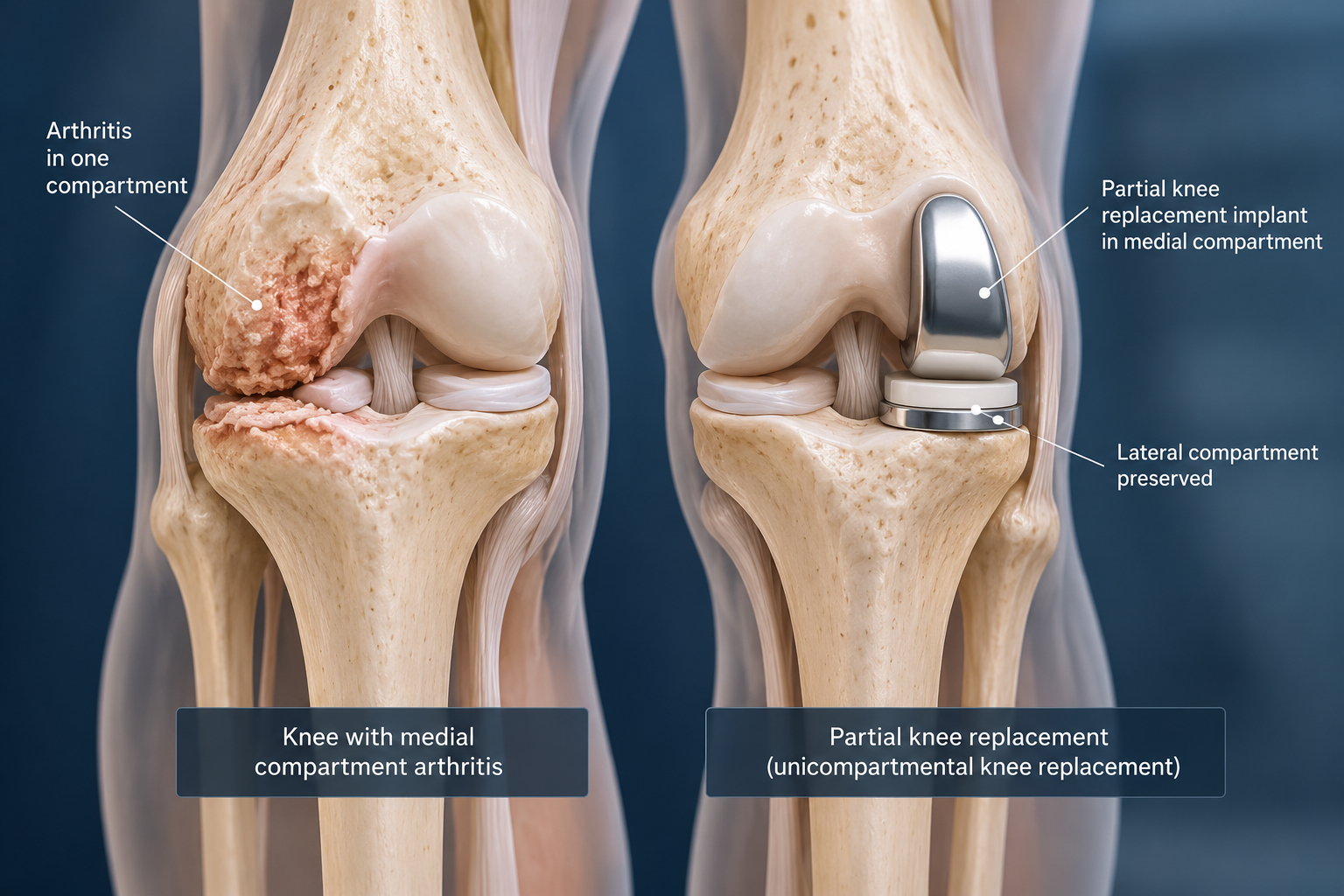
For some people with arthritis affecting only one part of the joint, a partial knee replacement may be an option. Instead of replacing all of the knee joint surfaces, the operation replaces only the damaged compartment while preserving healthy bone, cartilage and ligaments wherever possible.
For appropriately selected patients, this can help preserve more of the natural knee and may allow a quicker early recovery than a total knee replacement.
The important question is not simply whether you have knee arthritis, but where the arthritis is located and how much of the knee is affected.
What is a partial knee replacement?
The knee can be divided into three main compartments: the medial compartment on the inner side of the knee, the lateral compartment on the outer side, and the patellofemoral compartment between the kneecap and thigh bone.
When significant arthritis is confined to one compartment, it may not be necessary to replace the entire knee.
During partial knee replacement surgery, the damaged joint surfaces are resurfaced and replaced with an implant while the unaffected areas of the knee are preserved.
This is also known as unicompartmental knee replacement.
Who may be suitable for a partial knee replacement?
Partial knee replacement is not appropriate for every patient with knee arthritis.
Suitability depends on several factors, including:
- where the arthritis is located
- the condition of the remaining compartments of the knee
- the stability of the knee ligaments
- knee movement and alignment
- symptoms and activity levels
- X-rays and, where appropriate, other imaging
A specialist knee assessment is therefore important. The decision between partial and total knee replacement should be based on the individual knee rather than age alone.
What are the potential benefits of partial knee replacement?
Because more of the natural knee is preserved, partial knee replacement can offer several potential advantages for appropriately selected patients.
These may include:
- preservation of healthy bone and ligaments
- a less extensive operation than total knee replacement
- quicker early recovery for some patients
- a knee that may feel more natural following surgery
However, partial knee replacement is not automatically the better option. If arthritis affects several areas of the knee, a total knee replacement may provide the more appropriate treatment.
Partial or total knee replacement?
Partial knee replacement
Replaces only the arthritic compartment of the knee.
Preserves more of the patient’s natural knee.
May provide quicker early recovery for appropriately selected patients.
Best suited to arthritis limited to an appropriate part of the joint.
Total knee replacement
Resurfaces the major joint surfaces of the knee.
May be more appropriate when arthritis is widespread.
Treats disease affecting multiple compartments of the knee.
Requires a different recovery pathway.
Neither operation is universally better. The appropriate procedure depends on the pattern of arthritis, the condition of the knee and the individual patient. Explore knee replacement treatment options.
How long does recovery take after partial knee replacement?
Recovery varies between patients, but early recovery following partial knee replacement can be quicker than following total knee replacement.
Patients are usually encouraged to begin mobilising soon after surgery, with physiotherapy and rehabilitation helping to restore movement, strength and confidence.
Progressively, patients work towards everyday activities, driving, work and exercise. The exact timing depends on individual recovery, the type of activity and advice from the clinical team.
Knee Replacement Recovery Timeline: What to Expect Week by Week

What is a bicompartmental knee replacement?
For some patients, arthritis affects two compartments rather than one, while another part of the knee remains well preserved.
In selected cases, it may be possible to replace the affected areas while retaining healthy parts of the natural knee rather than progressing directly to a conventional total knee replacement.
Bicompartmental knee replacement requires careful patient selection and specialist assessment to determine whether it is appropriate.
Partial knee replacement with ACL reconstruction
In carefully selected patients, knee arthritis requiring partial replacement may coexist with instability caused by an anterior cruciate ligament (ACL) injury.
In certain circumstances, ACL reconstruction and partial knee replacement may be considered as part of the same treatment strategy. This is a specialist decision requiring detailed assessment of the knee, symptoms, activity requirements and imaging.
Specialist expertise in partial knee replacement

Mr Navjot Bhangoo is a Consultant Orthopaedic Knee Surgeon specialising exclusively in knee conditions and surgery.
His fellowship training included experience with Professor Jean-Noël Argenson in Marseille, an internationally recognised expert in partial knee replacement, and Mr Bhangoo teaches on the national partial knee replacement course.
His practice includes partial and total knee replacement as well as complex knee reconstruction, allowing treatment decisions to be based on the individual patient’s knee rather than a single surgical approach.
Find out more about Mr BhangooConsidering partial knee replacement?
Arrange a consultation with Mr Bhangoo to discuss your knee and the treatment options that may be appropriate for you.
Book appointmentFrequently asked questions about partial knee replacement
Is partial knee replacement better than total knee replacement?
Neither procedure is better for everyone. Partial knee replacement can be an excellent option when arthritis is limited to an appropriate area of the knee, while total knee replacement may be more suitable when arthritis is widespread.
How do I know if I am suitable for partial knee replacement?
Suitability is determined through your symptoms, examination and imaging. The location of the arthritis, ligament stability and condition of the remaining knee are particularly important.
Does a partial knee replacement feel more natural?
Because more of the natural knee, including healthy bone and ligaments, can be preserved, some patients report a more natural-feeling knee following partial replacement. Individual experiences vary.
Is recovery quicker after partial knee replacement?
Early recovery can be quicker following partial knee replacement than total knee replacement, although recovery varies considerably between individuals.
Can a partial knee replacement later be converted to a total knee replacement?
Further surgery can sometimes be required if the implant wears or arthritis progresses elsewhere in the knee. The options depend on the individual circumstances.
Am I too young or too old for partial knee replacement?
Age alone does not determine suitability. The pattern of arthritis, symptoms, general health, activity and condition of the knee all contribute to the decision.